The metric system is the world’s most widely recognized system of measurement. It is used in science, medicine, manufacturing, education, international trade, transportation, and everyday life. Whether you are measuring the length of a room, checking the weight of a package, reading a weather report, or following a recipe, metric units make it easier to communicate measurements clearly and consistently.
What Is the Metric System?
The metric system is a decimal-based measurement system in which units are related by powers of ten. This structure makes calculations and conversions easier because moving from one metric unit to another usually requires multiplying or dividing by 10, 100, 1,000, or another power of ten.
For example, one meter contains 100 centimeters, while one kilometer contains 1,000 meters. Instead of using unrelated conversion values, metric measurements follow a predictable pattern.
The modern form of the metric system is known as the International System of Units, commonly abbreviated as SI from its French name, Système international d’unités. The SI provides internationally agreed definitions for measurement units so that a meter, kilogram, or second represents the same quantity wherever it is used.
The International Bureau of Weights and Measures maintains information about the SI and works with national measurement organizations to promote consistent measurements worldwide.
A Brief History of the Metric System
Before standardized measurement systems were introduced, communities often relied on local units. Length might be measured using a person’s foot, hand, arm, or walking distance. Weight could be based on particular stones, seeds, or containers. Although these methods worked within small communities, they created confusion when people traded or communicated across different regions.
The metric system was developed in France during the late eighteenth century. Its creators wanted a rational and universal system that was not based on the body size of a ruler, the customs of one town, or an object that could change over time.
The meter was originally connected to the dimensions of the Earth, while the kilogram was associated with the mass of a specified volume of water. Physical standards were later produced to represent these units more precisely.
As science, transportation, and international trade expanded, more countries adopted metric measurements. International agreements eventually led to the creation of organizations responsible for maintaining common standards.
Measurement science continued to improve. Modern SI units are now defined through fixed constants of nature rather than depending entirely on physical objects. This approach helps ensure that units remain stable and can be reproduced with extremely high precision in laboratories around the world.
The Seven SI Base Units
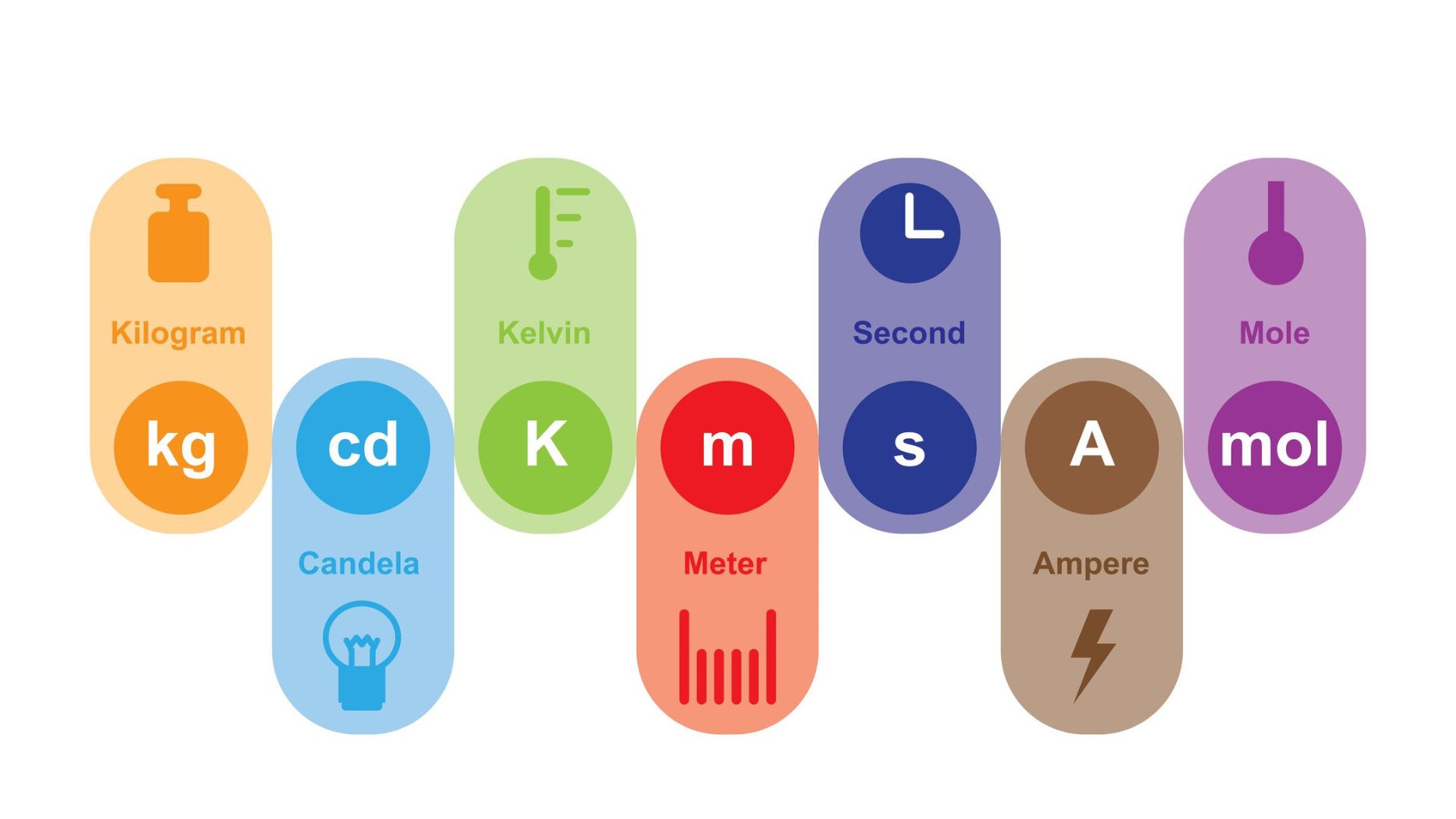
The International System of Units is built on seven base units. Other SI measurements can be derived from these foundational units.
1. Meter for Length
The meter, represented by the symbol m, is the SI base unit of length. It is used to measure distance, height, width, depth, and other linear dimensions.
Smaller and larger units are formed by adding prefixes. A millimeter is one-thousandth of a meter, a centimeter is one-hundredth of a meter, and a kilometer is one thousand meters.
When measurements are provided in feet, inches, yards, miles, meters, or kilometers, our Length Conversion tools can help you convert them quickly.
2. Kilogram for Mass
The kilogram, represented by kg, is the SI base unit of mass. It is commonly used for people, food, packages, equipment, and manufactured products.
One kilogram equals 1,000 grams. Smaller quantities may be expressed in grams or milligrams, while very large quantities can be measured in metric tonnes.
In daily conversation, people often use the words “mass” and “weight” interchangeably. Scientifically, however, mass describes the amount of matter in an object, while weight describes the force of gravity acting on that mass.
3. Second for Time
The second, represented by s, is the SI base unit of time. Seconds are used in clocks, scientific experiments, sports, computing, communications, navigation, and countless other applications.
Minutes, hours, and days are commonly used with SI measurements even though their relationships do not follow a simple power-of-ten structure.
4. Ampere for Electric Current
The ampere, represented by A, measures electric current. It describes the rate at which electric charge flows through a conductor.
Ampere ratings appear on electrical equipment, household circuits, batteries, chargers, power supplies, and industrial machinery.
5. Kelvin for Temperature
The kelvin, represented by K, is the SI base unit of thermodynamic temperature. It is especially important in scientific research.
Celsius is more commonly used for weather, cooking, and everyday temperature readings in many countries. A change of one kelvin is equal in size to a change of one degree Celsius, although the two scales begin at different zero points.
6. Mole for Amount of Substance
The mole, represented by mol, measures the amount of a substance. It is mainly used in chemistry and related scientific fields.
The mole allows scientists to work with enormous numbers of atoms, molecules, ions, and other microscopic particles using manageable numerical values.
7. Candela for Luminous Intensity
The candela, represented by cd, measures luminous intensity in a particular direction. It is used when describing and testing light sources such as lamps, displays, warning lights, and vehicle lighting.
The National Institute of Standards and Technology’s guide to SI units provides additional information about the seven base units and the derived units built from them.
Understanding Metric Prefixes
Metric prefixes indicate whether a unit is larger or smaller than its basic form. Because these prefixes represent powers of ten, they make it possible to describe extremely small and extremely large quantities without writing long strings of zeros.
| Prefix | Symbol | Meaning | Example |
|---|---|---|---|
| Kilo | k | 1,000 units | 1 kilometer = 1,000 meters |
| Hecto | h | 100 units | 1 hectometer = 100 meters |
| Deca | da | 10 units | 1 decameter = 10 meters |
| Deci | d | 0.1 unit | 1 decimeter = 0.1 meter |
| Centi | c | 0.01 unit | 1 centimeter = 0.01 meter |
| Milli | m | 0.001 unit | 1 millimeter = 0.001 meter |
| Micro | µ | 0.000001 unit | 1 micrometer = 0.000001 meter |
| Nano | n | 0.000000001 unit | 1 nanometer = 0.000000001 meter |
The most familiar prefixes in everyday life are kilo, centi, and milli. Kilometers are used for road distances, centimeters for the dimensions of smaller objects, millimeters for precise measurements, kilograms for body mass, and milligrams for very small amounts.
How Metric Conversions Work
Converting between metric units is usually straightforward because the units are connected by powers of ten. The key is determining how many places the decimal point must move.
Converting Meters to Centimeters
One meter equals 100 centimeters. To convert meters to centimeters, multiply the value by 100.
Example: 2.5 meters × 100 = 250 centimeters.
Converting Centimeters to Meters
To convert centimeters to meters, divide the value by 100.
Example: 475 centimeters ÷ 100 = 4.75 meters.
Converting Kilograms to Grams
One kilogram equals 1,000 grams. Therefore, kilograms can be converted to grams by multiplying by 1,000.
Example: 3.2 kilograms × 1,000 = 3,200 grams.
Converting Grams to Kilograms
To convert grams to kilograms, divide by 1,000.
Example: 850 grams ÷ 1,000 = 0.85 kilograms.
Conversions involving pounds, ounces, kilograms, grams, stones, or tonnes require different conversion factors. For these calculations, you can use our Weight Conversion tools instead of calculating every result manually.
Derived Metric Units
Many measurements are created by combining SI base units. These are known as derived units.
Speed, for example, can be expressed in meters per second. Area is measured in square meters, while volume can be measured in cubic meters. Density may be expressed in kilograms per cubic meter.
Some derived units have special names. The newton measures force, the pascal measures pressure, the joule measures energy, the watt measures power, and the volt measures electric potential.
Derived units allow scientists, engineers, manufacturers, and other professionals to describe complex physical quantities using a consistent measurement framework.
Where the Metric System Is Used
Science and Research
Scientists use SI units to communicate results consistently. A researcher in one country should be able to understand and reproduce measurements recorded by a researcher in another country.
Standard units are particularly important in fields such as physics, chemistry, astronomy, biology, medicine, and environmental science.
Healthcare and Medicine
Medical professionals use metric units to record body mass, medication quantities, fluid volumes, laboratory values, and medical equipment settings.
Medication doses may be expressed in grams, milligrams, micrograms, or milliliters. Because mistakes can have serious consequences, healthcare measurements must be recorded and interpreted carefully.
Transportation
In countries that use the metric system, road distances are generally displayed in kilometers and vehicle speeds in kilometers per hour. Fuel is commonly sold by the liter, while tire pressure may be expressed in kilopascals.
Construction and Manufacturing
Builders, architects, engineers, and manufacturers use metric units for dimensions, materials, tolerances, areas, volumes, and loads.
Millimeters are particularly useful in technical drawings because they allow precise dimensions to be shown without relying heavily on fractions.
Food and Cooking
Recipes may specify ingredients in grams, kilograms, milliliters, or liters. Metric measurements are especially helpful in baking, where accurate ingredient proportions can affect the final result.
Weather Reporting
Celsius is used for temperature reporting in much of the world. Rainfall is often measured in millimeters, visibility in meters or kilometers, and wind speed in meters per second or kilometers per hour.
Retail and International Trade
Metric units are used for product dimensions, package weights, liquid quantities, shipping information, and manufacturing specifications. Shared measurement standards help businesses avoid misunderstandings when buying and selling goods internationally.
Why the Metric System Is Useful
One of the main advantages of the metric system is its logical structure. Units within the same measurement category are connected through powers of ten, reducing the number of conversion factors that must be memorized.
The system is also scalable. The same base unit can describe very small or very large quantities simply by adding an appropriate prefix.
Another important advantage is international consistency. Standardized units make it easier to exchange scientific data, manufacture compatible parts, ship products, teach measurement skills, and compare information across countries.
The metric system does not eliminate every measurement challenge. Users must still select the correct unit, record the proper symbol, and apply accurate conversion factors. However, its decimal structure makes many common calculations easier to understand and verify.
Common Mistakes When Using Metric Units
Confusing Mass and Weight
Mass and weight are related but scientifically different. Kilograms measure mass, while force is measured in newtons. In everyday contexts, however, kilograms are commonly described as units of weight.
Using Incorrect Capitalization
SI symbols are case-sensitive. A lowercase m represents a meter, while an uppercase M is used for the prefix mega. Similarly, kg is correct for kilogram, not “KG” or “Kg.”
Adding an “s” to Unit Symbols
Unit names can be plural, but their symbols do not change. You may write “five kilometers,” but the correct symbol remains “5 km,” not “5 kms.”
Forgetting That Area and Volume Conversions Are Different
Length conversion factors must be squared when converting area and cubed when converting volume. Because one meter equals 100 centimeters, one square meter equals 10,000 square centimeters—not 100 square centimeters.
Rounding Too Early
Rounding during an intermediate calculation can reduce the accuracy of the final result. Keep several decimal places throughout the calculation and round only after the conversion is complete.
Tips for Learning Metric Measurements
Start by becoming familiar with common reference points. A typical doorway is roughly two meters high, a small paper clip is a few centimeters long, and a standard bottle of water may contain around 500 milliliters.
Practice estimating measurements before checking them with a ruler, scale, or measuring container. This helps develop an intuitive understanding of metric units.
Learn the most common prefixes first: kilo, centi, and milli. Once these relationships are familiar, less frequently used prefixes become easier to understand.
Finally, verify important conversions with a reliable calculator. This is particularly useful when converting between metric and non-metric units or when working with area, volume, and precise decimal values.